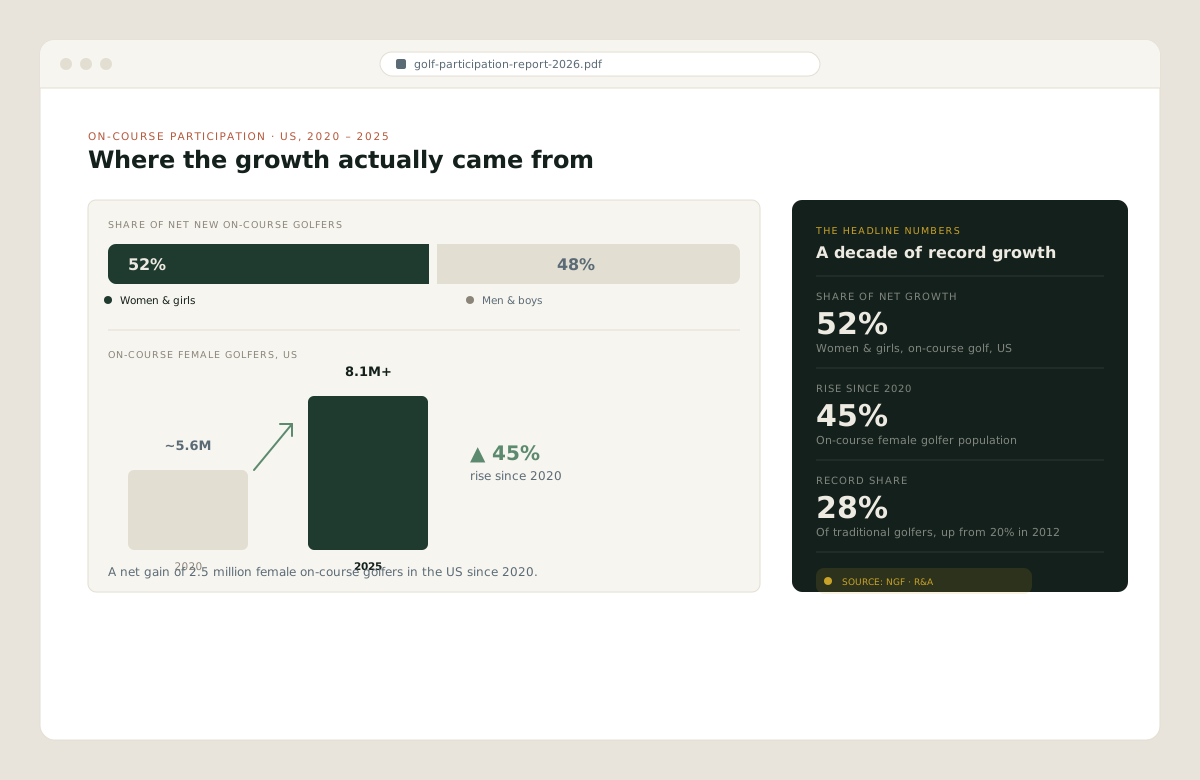
The National Golf Foundation's data is specific enough to take seriously. Between 2020 and 2025, the number of on-course female golfers in the US rose 45%, a net gain of 2.5 million players, taking the total to more than 8.1 million. Women and girls accounted for 52% of the entire net increase in on-course participation over that period, across every age group the NGF tracks. Female representation within the traditional golfer population now stands at a record 28%, up from 20% in 2012.
None of that came from men leaving the game. The male on-course population grew too, by 12% and a net 2.3 million players over the same five years. Women's golf participation growing this quickly is a genuine expansion of who plays, not a redistribution of who used to.
What is driving women's golf growth elsewhere
The R&A's Global Golf Participation Report describes the same shift internationally, and is explicit that it reflects widening access rather than any pullback in male participation. Women now represent 34% of adult golfers across the R&A's key markets globally, up from 31% the year before, with wide variation by country.
Alternative formats are doing a lot of the work. Driving ranges, indoor simulators, and short-format facilities are functioning as a genuine on-ramp rather than a substitute for the traditional game. The R&A's data found that more than a third of on-course golfers in Canada and England started through a non-traditional format first. Women make up roughly half of adult players in those alternative formats, which means the on-ramp itself is already close to balanced, even where the traditional membership base is not.
Why the UK appears to be behind on this specific measure
This is where a UK club needs to read the numbers carefully rather than pick whichever one sounds best. Different sources measure different populations, and they do not agree.
England Golf's own membership data puts women at around 14% of registered golf club members in England. Broader estimates of all adult golfers across Great Britain and Ireland, a wider population that includes casual and occasional players, put the figure closer to 20%. The R&A's own headline figure for Great Britain and Ireland, 33%, is wider still, because it counts all adult participants including alternative-format players at ranges and simulators, not specifically club members or traditional on-course golfers.
None of these numbers is wrong. They are measuring different things. For a club looking at its own membership roll, the relevant comparison is club membership to club membership, and on that measure the UK sits meaningfully behind the US's 28% and the higher end of the R&A's country-by-country figures, even as junior participation in the UK grows sharply across genders. Encouragingly, one in three new golfers entering the game in the UK is now female. The pipeline is already shifting. Club membership has not caught up with it yet.
Tee time access is where this becomes concrete
Policy that never mentions gender can still restrict access unevenly. A club whose competition slots, society bookings, and informal roll-up culture are built around a working pattern and social rhythm that suits one group over another is not neutral just because the rule book does not say so.
Worth reviewing specifically: whether peak tee times are effectively reserved for existing competition formats that skew toward one membership group by habit rather than by rule, whether a new member without an established social group can get a regular game at a time that works for them, and whether ballot or booking systems that have run unchanged for years are quietly reinforcing whoever already has priority. None of this requires a policy rewrite framed around inclusion. It requires an honest look at who is actually getting the tee times that matter.
Membership category design matters more than marketing does
A membership structure built entirely around a single full-access category, priced and timed for one kind of member, does not flex easily for someone testing the game or fitting golf around childcare and work. Flexible membership categories, genuine off-peak or flexible-hours options, and family structures that do not require every adult to buy the same full category, lower the barrier to trying the club at all.
This is not about creating a special category by gender. It is about making sure the categories that exist actually fit how a growing part of the golfing population wants to play, whether that is a parent working around school hours or a couple sharing a membership rather than duplicating one.
Coaching, taster programmes, and the route in
Given that alternative formats are the genuine on-ramp the data shows, a club's own taster and beginner coaching should treat that on-ramp as real rather than assume everyone starts on the first tee. A short, structured beginner pathway, from a simulator or range session through to a supervised nine holes, mirrors how the growth is actually happening rather than expecting someone to arrive already golf-literate.
Group coaching cohorts, run at times that suit people fitting golf around work and family rather than only during traditional weekday club hours, remove a second quiet barrier. The clubs seeing the fastest uptake are treating this as a scheduling and coaching capacity question, not a marketing campaign.
What the clubhouse actually says to a prospective member
Marketing materials are a more literal signal than most clubs realise. A website built entirely around photography of one type of member, a noticeboard dominated by one competition format, or a welcome pack that assumes a particular kind of prior experience, tells a prospective member something before they have even visited. None of this requires new copywriting rules. It requires an honest look at whether the club's own materials reflect who it says it wants to attract, or only who already belongs.
Whether that applies more to a private members' club with an established culture to shift, or a public course building a first impression from scratch, the underlying question is the same. Does what a prospective member sees before they arrive match what the participation data says is actually happening in the sport.
The clubs that close this gap first will not do it with a campaign. They will do it with tee sheets, categories, and coaching rotas that were quietly built to fit the game as it actually grows, not as it looked a decade ago.
Adam Lynch is the founder of Verro. He previously served as Assistant Director of Digital Media at The R&A and as CEO of WooRank, a SaaS platform acquired in 2023.