A committee added a midweek category for a group of retired members in 2015. Someone approved a family rate in 2018 that nobody has reviewed since. A junior tier got a new name three chairmen ago and kept the old entitlements. Ten years later, nobody in the office can explain the difference between two categories without pulling up the constitution.
The pressure to get this right has not eased. The UK golf courses industry comprises around 2,510 businesses and was projected to reach roughly £2.8 billion by 2026, yet total club membership numbers have fallen by around 150,000 over the past decade. That is not really a contradiction. It is two things happening at once: a resilient industry overall, and a long-term contraction in traditional membership at plenty of individual clubs. A category structure built for 900 members in 2015 rarely still fits a club of 700 in 2026.
Why category sprawl happens
Category sprawl rarely happens by decision. It happens by accretion. A one-off arrangement for a founder member's family becomes a standing category because reversing it would cause a row nobody wants at committee. A pandemic-era discount turns into a permanent tier because nobody revisited it once the clubhouse reopened. Each addition solved a real problem at the time. None of them were designed against the categories already on the books.
The result is a structure only the person who has worked in the office for a decade can navigate. A new membership secretary inherits a spreadsheet of exceptions, not a policy.
Before adding a category, or reviewing an existing one, it helps to separate two questions that get conflated constantly: what does this category cost, and what does it actually entitle a member to. Sprawl usually comes from clubs solving a pricing problem by inventing a new category, when the real fix was an entitlement change within an existing one.
The categories most clubs actually need
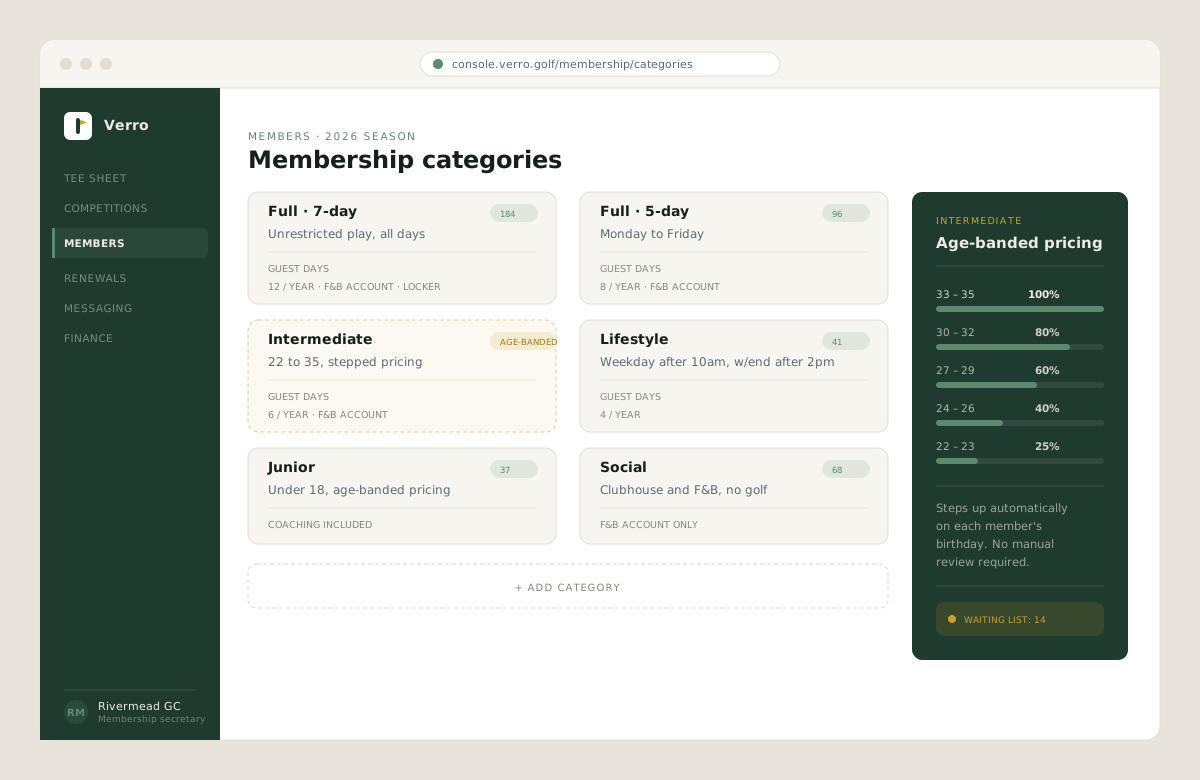
Most clubs, regardless of size, need some version of five categories. Fewer than that and pricing cannot flex to member circumstances. More than that and almost nobody at the club can describe the differences accurately.
Full access. Unrestricted play, every day the course is open. This is the category every other category gets measured against, so its entitlements need to be the most clearly defined of all of them: guest day allowance, F&B account access, locker allocation, competition eligibility.
Time-restricted. Access limited to specific days or times, priced below full access accordingly. This is where most of a club's category variation should actually live, rather than in a proliferation of near-identical full categories.
Age-banded. A stepped pricing path for younger members, usually running from the early twenties to the early thirties, that increases automatically as a member ages rather than requiring a manual review. Clubs that get this category right retain members through the years they are most likely to lapse on cost alone.
Social or non-playing. Clubhouse and F&B access without golf. Increasingly relevant as clubs diversify revenue beyond green fees and subscriptions.
Junior. Under-18 membership, typically with its own age-banded structure and often bundled with coaching. The Golfshake 2025 Club Membership Survey, based on responses from over 2,500 golfers gathered in October 2025, found junior participation showing the largest year-on-year gain of any group measured, part of a wider pattern our piece on junior golf's growth covers in more depth. A category that is easy for parents to understand, and priced sensibly against that trend, is worth getting right.
Everything else, a reduced-rate category for a specific life stage, a bundled family rate, is usually a variation on one of these five, not a sixth foundation. Naming it as a variant, rather than a new category built from scratch, is what keeps the structure explainable.
One variant deserves its own mention, because it is one of the more common structural additions clubs are making at the moment. A midweek-daytime, or "lifestyle", category, priced below full access and restricted to specific windows, is aimed squarely at golfers in their twenties and thirties whose work and family commitments do not fit a traditional weekend-and-evenings pattern. It is a direct response to how work and lifestyle patterns have shifted, not a discount dressed up as a category. Structured with its own clear entitlements, rather than borrowed from an existing tier, it can bring in members a full category never would have reached.
Age-banded pricing without an unmanageable system
Age-banded pricing is one of the most valuable tools available to a membership committee, and one of the easiest to build into something nobody can actually run. A ladder with a step for every single age, reviewed manually each year, is a maintenance burden that eventually gets neglected. A member turns 31 and stays on the 30 percent rate for two more years because nobody caught it.
The versions that work well use a small number of bands, typically four or five, each covering two or three years, stepping automatically on a member's birthday rather than at an annual review point. A member moving from one band to the next should be a system event, not a task on someone's list every January.
This only works if the bands are visible and predictable. A member in their mid-twenties should be able to see exactly when their rate changes and what it changes to. Uncertainty about future cost is one of the more common sources of quiet resentment in a membership base, and it costs nothing to fix with a clearly published ladder.
Entitlements matter as much as price
A category is not really defined by what it costs. It is defined by what it entitles a member to, and clubs that only think in price bands end up with categories that are functionally identical except for a number.
Three entitlements do most of the differentiating work in practice: guest days, F&B account access, and locker allocation. A full category with a generous guest allowance, an F&B account, and a locker is a genuinely different proposition from a time-restricted category without those, even before the price difference is considered. Members understand entitlement differences intuitively in a way they do not always understand pricing logic.
Getting this right also settles an argument that comes up at almost every club eventually: a member on a cheaper category who feels entitled to the same access as full members. A documented entitlement table, not a verbal understanding passed between secretaries, closes that down before it starts.
How a waiting list interacts with your category structure
Waiting lists are becoming more common, not less. The Golfshake 2025 survey found 30 percent of golfers report their club operates a waiting list, up from 27 percent the year before, alongside 39 percent reporting a joining fee, up from 37 percent. Both figures moving in the same direction points to genuine demand pressure at plenty of clubs, not just clubs tightening admission for its own sake.
A waiting list only functions properly against a clear category structure. If a club cannot say precisely which category a waiting member is queuing for, and what entitlements that category carries, the list becomes a source of dispute rather than a fair queue. Clubs that run waiting lists well tend to run them per category, not as one undifferentiated queue, because demand for full access and demand for a time-restricted or social category rarely move together.
Cost pressure adds to this. 81 percent of golfers surveyed expect membership costs to rise again in 2026. A club that can explain exactly what a price increase applies to, because its categories and entitlements are clearly defined, has a far easier conversation with its membership than one asking for a blanket increase across a structure nobody can fully describe.
What this means for your club
None of this needs to happen all at once. Reviewing a membership structure mid-season, with renewals already sent and pricing already communicated, usually causes more disruption than the sprawl it is trying to fix. The better approach is an annual structural review, kept separate from the pricing conversation, where the committee asks a narrower question: does every category still have a clear, distinct purpose, and can every entitlement be stated in one sentence.
If the answer is no for more than one or two categories, that is the starting point for next year's structure, not this year's emergency fix.
Verro's membership module is built around this reality: unlimited categories, so a club is never forced to squeeze a new arrangement into an existing tier, age-banded pricing that steps up automatically on a member's birthday rather than needing a manual review, and entitlements, guest days, F&B account access, locker allocation, configured per category rather than tracked separately from price.
Book a demo and bring your own category list. We will show you what it looks like structured properly.
Adam Lynch is the founder of Verro. He previously served as Assistant Director of Digital Media at The R&A and as CEO of WooRank, a SaaS platform acquired in 2023.