WHS gets treated as background noise. It sits quietly behind every competition, every medal round, every casual game a member logs, and most club staff only think about it when something goes wrong. A score does not post. An index jumps in a way nobody can explain. A member asks why their handicap at your club does not match what they thought it should be.
None of that is a software problem first. It is a gap in understanding how WHS works, who governs it, and what a club's system is actually supposed to be doing with it. Close that gap and the software questions get much easier to answer.
Where WHS came from, and who runs it
The World Handicap System is younger than most people assume. The idea for a single, unified handicap system was first raised in 2011, as a joint project between the USGA and The R&A. It took years of work before it became real.
That work involved a proper review of the handicapping authorities already running their own systems around the world: Golf Australia, CONGU (the Council of National Golf Unions, covering Great Britain and Ireland), the European Golf Association, the South African Golf Association, the Argentine Golf Association, and the USGA itself. In February 2018, the USGA and The R&A formally announced the system that would replace all six. WHS launched in 2020.
The governance did not disappear once the six systems merged. WHS is jointly governed worldwide by the USGA and The R&A, but neither body issues handicaps directly to individual golfers. That job sits with national and regional golf associations, who administer WHS locally under the shared rules. In Great Britain and Ireland, this happens through the home unions. Your club's connection to WHS runs through your union or national association, not directly to St Andrews or New Jersey.
WHS also covers more than the index calculation most people picture. It encompasses both the Rules of Handicapping and the Course Rating System, formerly known as the USGA Course Rating System. The two are connected. One produces a portable number for a golfer. The other produces the course-specific data that number depends on.
The system has changed since 2020, and it will keep changing. A significant set of updates was introduced from January 2024, following a three-year period in which the governing bodies gathered feedback from golfers and associations worldwide. Software that talks to WHS needs to track those changes as they happen, not treat 2020 as a fixed specification.
What WHS actually calculates
Four terms do most of the work, and club staff use all four without always distinguishing what each one measures.
Course Rating is a measure of how difficult a course plays for a scratch golfer, expressed as a number close to par. Slope Rating measures how much harder that same course plays for a higher handicap golfer relative to a scratch golfer. A course can carry a modest Course Rating and still play brutally for a mid or high handicapper if the Slope Rating is high.
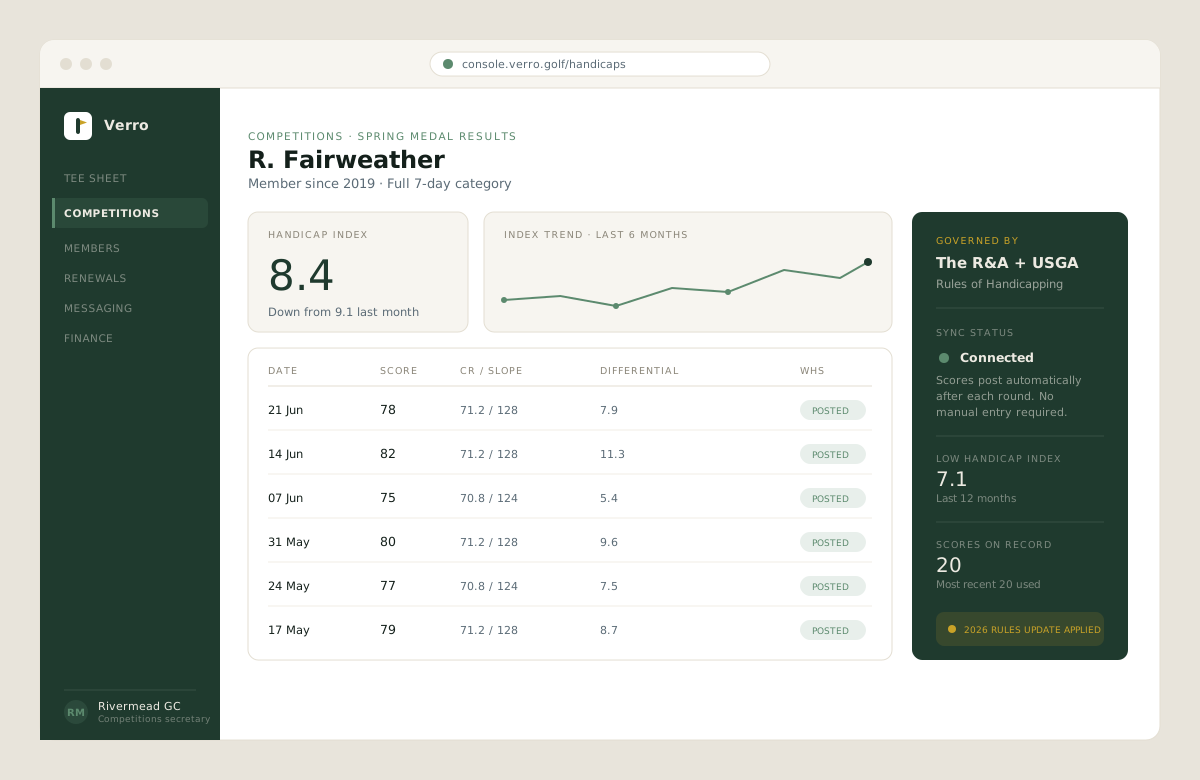
Score Differential is what turns a single round into a number that can be compared against a round played anywhere else in the world. It takes the adjusted score a golfer returns and weighs it against the Course Rating and Slope Rating of the course played that day, along with a playing conditions adjustment. A 78 shot on a hard course and an 82 shot on an easy one can produce a very similar differential.
Handicap Index is the number a member actually carries. Under the Rules of Handicapping, it is calculated from the best differentials among a golfer's most recent scores, not a simple average of everything they have played. That is why an index can improve on the back of one outstanding round without every round since needing to match it, and why it does not collapse after a single bad one.
Why the governance structure matters for your club
Before 2020, a handicap earned under CONGU did not automatically mean the same thing as one earned under the USGA system. The formulas differed. The definitions of an acceptable score differed. A member moving between countries, or a club comparing a visiting golfer's handicap against its own members, was comparing numbers that were not built the same way.
Joint governance by the USGA and The R&A, with administration through national and regional associations, exists specifically to remove that inconsistency. A rule change happens once, at the top, and applies everywhere WHS operates. Your union does not invent its own variation of how a Score Differential is calculated. That consistency is the entire point of the exercise, and it is what makes a Handicap Index genuinely portable between clubs and countries.
For a club running competitions week in, week out, this matters practically. Your software is not connecting to a private database your club controls. It is connecting to a governed system with rules your club does not set and cannot quietly override, however local habit might suggest otherwise.
What automatic score posting should actually mean
"Automatic score posting" gets used loosely by software vendors. Said properly, it means this: when a member returns an acceptable score in a qualifying round, that score reaches WHS without a human re-typing it into a separate system afterwards.
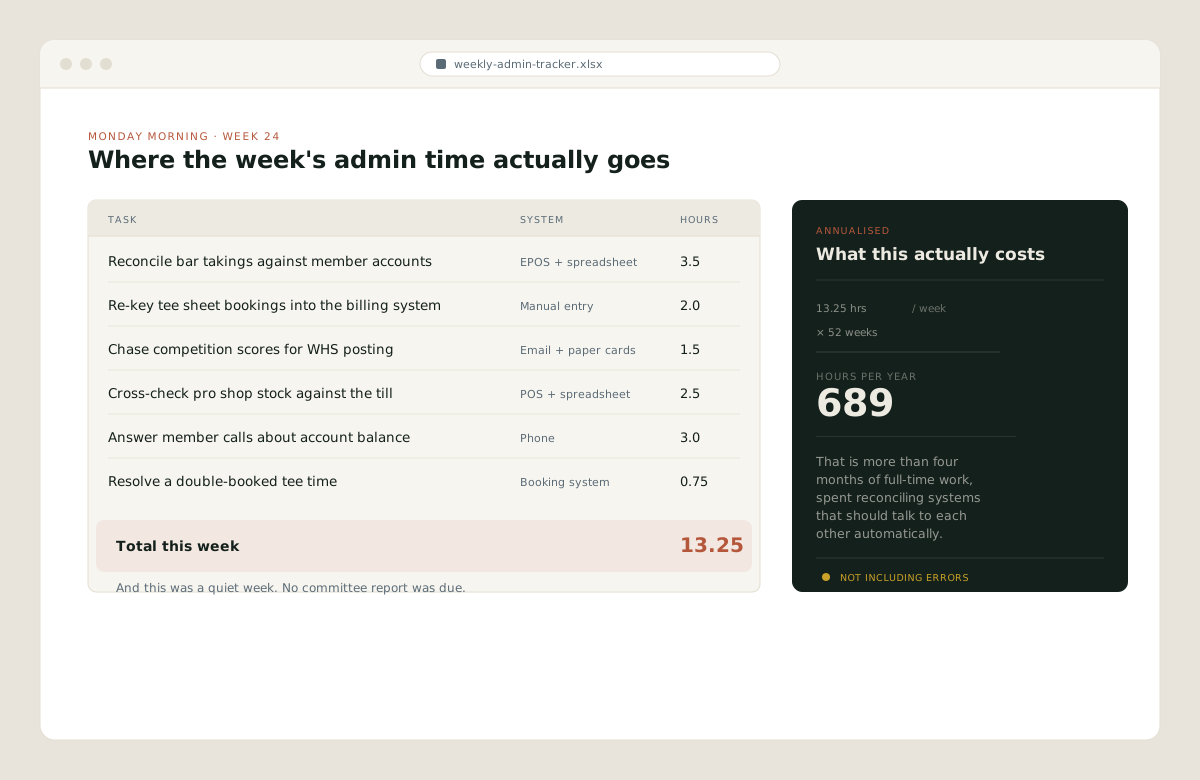
In practice, that requires a direct connection between your club's software and the WHS database through your union's API, not a spreadsheet export a competition secretary uploads once a week. Every manual step between a scorecard and WHS is a place where a score gets delayed, entered against the wrong course rating, or simply forgotten during a busy Saturday.
The clubs that get frustrated with WHS are, more often than not, clubs whose software treats posting as an extra task rather than a built-in consequence of running the competition. If your competitions secretary is still manually keying scores into a union portal after every medal, the software is doing the easy part and leaving your club to do the hard part.
Automatic score posting is also a useful example of what genuine, working automation in club software actually looks like, as opposed to the broader AI claims now doing the rounds. We cover that distinction in more detail in our reality check on AI in golf club management.
Common points of confusion at club level
A few questions come up at almost every club, regardless of size.
Why did my index move after one round? Because a Handicap Index is not a rolling average of every score a member has ever returned. It draws from a limited set of recent differentials, so a single very good or very poor round can shift it more than members expect. WHS also limits how far an index can rise after a poor round, through capping rules built into the system, which is why a single disastrous 95 rarely sends someone's index up by several shots overnight.
What counts as an acceptable score? Broadly, a score returned under the Rules of Golf, over the required number of holes, in a round played the way the format demands. A friendly nine holes with no card kept is not an acceptable score. A medal round played to the format and properly recorded is. Club software should apply this distinction automatically rather than leaving a competition secretary to judge it round by round.
Is WHS the same as my competition handicap? No, and this is the confusion that causes the most arguments on a Saturday. A Handicap Index is a portable number. A competition handicap, or playing handicap, is what a club or format does with that index once a course and a set of allowances are applied. A club running a stableford off a reduced allowance is not changing anyone's WHS index. It is applying its own competition rules on top of it, which is entirely normal and entirely separate from the number WHS itself produces.
What this means for your club's software
None of this needs to be complicated for the people running your club day to day. It needs software that gets the mechanics right so your staff do not have to think about them constantly.
A member's Handicap Index should come from WHS directly, not from a locally stored number your system quietly falls out of sync with. Acceptable scores from qualifying competitions should post without a manual step. And competition or playing handicaps should be calculated and displayed as what they are: your club's own application of allowances on top of a governed number, never confused with the index itself.
Verro's competitions module includes what we call a score posting hook. Once your club's R&A or union API access is confirmed, results from qualifying rounds post to WHS as part of finishing the competition, not as a separate task someone remembers to do afterwards. Nothing to retrofit, nothing to re-key.
Book a demo and we will show you exactly how it works with your club's own union connection.
Adam Lynch is the founder of Verro. He previously served as Assistant Director of Digital Media at The R&A and as CEO of WooRank, a SaaS platform acquired in 2023.