Switching software feels disruptive, so a lot of clubs stay with what they have rather than face the upheaval of moving. Staying put has a cost too. It just does not appear on an invoice. It shows up as an extra hour on a Monday morning, a phone call to a member that should not have been necessary, and a competition result that never quite made it into the system it needed to reach.
This is not a pricing comparison. It is an attempt to count what fragmentation actually costs, in hours and in the errors those hours create.
Where the week's admin time actually goes
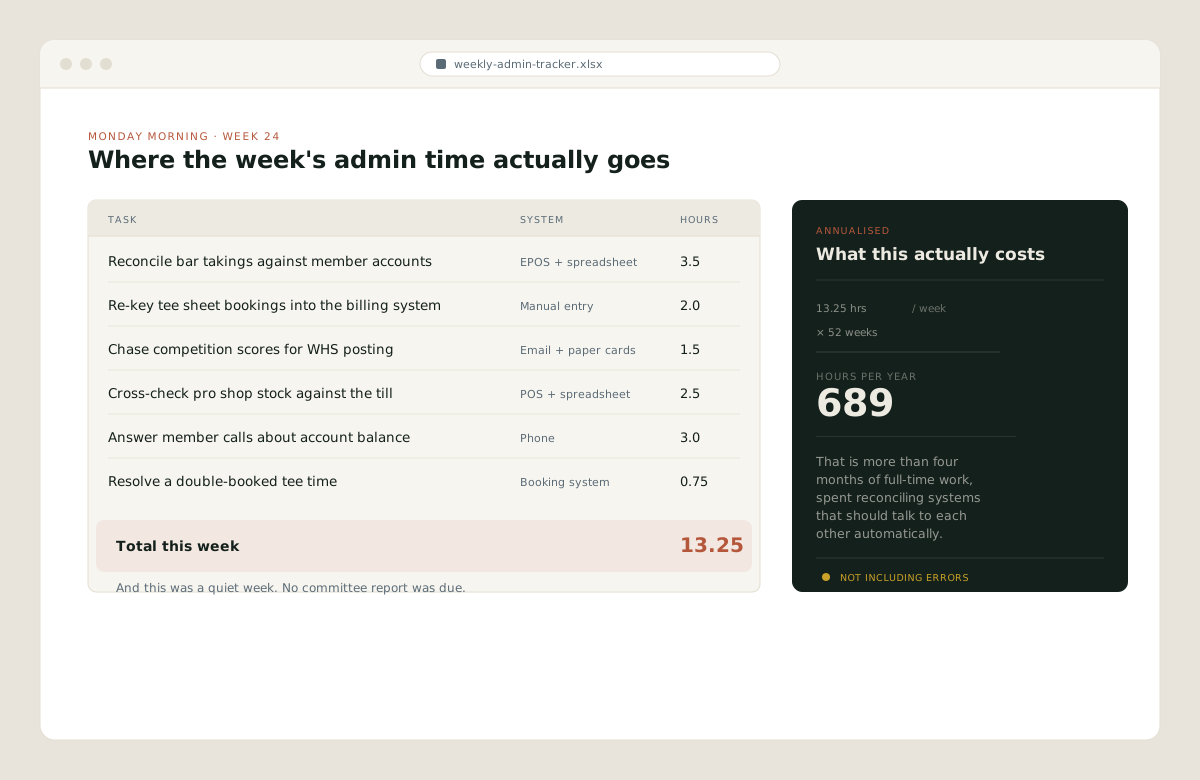
We asked a membership secretary at a mid-sized members' club to track, honestly, where a single ordinary week of admin time went. Not a busy week. A quiet one, with no committee report due and no major competition running. The tracker above is what she found.
Reconciling bar takings against member accounts. The EPOS system and the membership spreadsheet do not talk to each other, so every tab has to be checked by hand. 3.5 hours.
Re-keying tee sheet bookings into the billing system. The booking software and the billing software are separate products, so green fees get typed in a second time. 2 hours.
Chasing competition scores for WHS posting. Cards come back on paper or by email, and someone has to collect them all before they can be posted. 1.5 hours.
Cross-checking pro shop stock against the till. Two more systems, neither aware of the other's numbers. 2.5 hours.
Answering member calls about account balance. Members have no way to check this themselves, so they ring the office instead. 3 hours.
Resolving a double-booked tee time. Two systems held two versions of the same Saturday morning. 45 minutes.
Total for the week: 13.25 hours. And, as the tracker notes, this was a quiet one.
What 13.25 hours a week actually costs
On its own, 13.25 hours a week does not sound alarming. Multiply it by 52 weeks and it becomes 689 hours a year. That is more than four months of a full-time role, spent entirely on reconciling systems that should exchange information automatically.
This is not a one-off migration cost. It recurs every year, for as long as the club keeps the same combination of systems in place. A club that has run separate systems for six years has spent the better part of two full-time years on admin that produced nothing a member would ever notice or thank the club for.
And the 689 hours only covers the reconciliation itself. It does not include the time spent fixing what the reconciliation misses.
The errors that come from running separate golf club management systems
Every manual re-entry is a chance for a number to change on the way from one system to another. A membership secretary typing a green fee into a billing system from a tee sheet printout will occasionally transpose two digits, skip a row, or apply last month's rate. This is not a lack of care. It is what happens when a task has to be done by hand, dozens of times a week, indefinitely.
The pattern is predictable. Errors surface furthest from where they were made, and closest to where a member notices them. A stock count that does not match the till gets written off as shrinkage. A balance that does not match a bank statement gets explained away as a rounding difference. Each error on its own looks small. Over a season, the pattern is not.
What members see when something falls through the gap
Members do not see spreadsheets. They see the result. Three examples come up often enough to be predictable rather than unlucky.
A double-booked tee time. Two systems held two versions of the same Saturday morning, and neither flagged the clash until both groups arrived at the first tee. The member does not care which system was at fault. They remember standing on the tee with someone else's four-ball.
A member charged twice. The billing system and the EPOS system both recorded the same bar tab, one from a manual entry and one from the terminal, and nobody caught the duplicate before the statement went out. The member has to notice it, query it, and wait for someone to work out what happened, on a charge the club already had the information to catch before it was ever sent.
A competition result that never made it to WHS. A card was handed in and logged on paper, and the person who keys results into the handicap system was away that week. The member's handicap index does not update. They find out weeks later, often when it affects their entry into another competition.
None of these is a dramatic failure. That is exactly the problem. A club can absorb one of them without much fuss. A club running several disconnected systems produces them often enough that members start to expect the club to get something wrong, and that expectation is hard to undo once it sets in.
Replacing separate golf club management systems with one connected record
The alternative to reconciling systems is not reconciling them faster. It is not needing to reconcile them at all, because there is only one record of a member to begin with.
Verro holds membership, the tee sheet, competitions, billing, and the till against a single member record across the full Verro platform. A booking, a bar tab, and a competition entry are the same piece of data seen from three angles, not three separate entries that have to be made to agree with each other after the fact. There is nothing to reconcile because there is nothing duplicated in the first place.
What to do with this
Before deciding whether switching software is worth the disruption, run this audit at your own club. Ask two or three staff to track their week honestly, task by task, for one ordinary week. Multiply the weekly total by 52. Compare that figure, not a licence fee, against the cost of a connected system.
Staying with what you have is not free. It has simply been costing the club in a currency that does not appear on an invoice: staff time, member trust, and the small mistakes that come from doing the same manual task hundreds of times a year.
Whether you run a members' club, a multi-course group, or a public course, the shape of this problem is the same wherever staff are copying information from one screen to another. See how Verro fits clubs like yours, or book a demo and bring your own numbers.
Adam Lynch is the founder of Verro. He previously served as Assistant Director of Digital Media at The R&A and as CEO of WooRank, a SaaS platform acquired in 2023.