Late membership renewal is expensive in ways that do not show up on a single line of the accounts. It ties up staff time chasing payments that should have arrived weeks earlier. It creates awkward conversations at the bar between a member who has not paid and a committee deciding whether to let them play anyway. It delays cash the club needs most at exactly the point in the year, usually before the season starts, when it matters most.
None of this requires heavier-handed enforcement. It requires a renewal process built around how members actually behave, not one that assumes they will read a letter in January and act on it in February.
Why members pay late
It helps to separate the reasons, because each one needs a different fix. In most clubs, late payers fall into three groups.
The forgetters. They intend to pay and simply do not register the deadline. A single renewal letter sent in December, read once and then buried under other post, is not enough to hold their attention through to a January or February due date.
The friction-averse. They intend to pay but the process is annoying enough to put off. A cheque that needs writing and posting. A bank transfer that requires finding the club's account details again. A form that has to be printed and handed to someone in the office.
The genuinely stretched. A small number of members are paying a significant sum in one go at a time of year that does not suit their finances. For this group, the barrier is not forgetfulness or friction. It is the size and timing of the payment itself.
A club that sends one reminder letter and one payment method is only partially addressing the first group. The other two need different fixes entirely.
Renewal timing and communication cadence
Most clubs send a renewal notice too late and follow it up too rarely. A single letter in December, followed by silence until a chasing email in March, gives members almost no reason to act early and every reason to leave it until the deadline is already close.
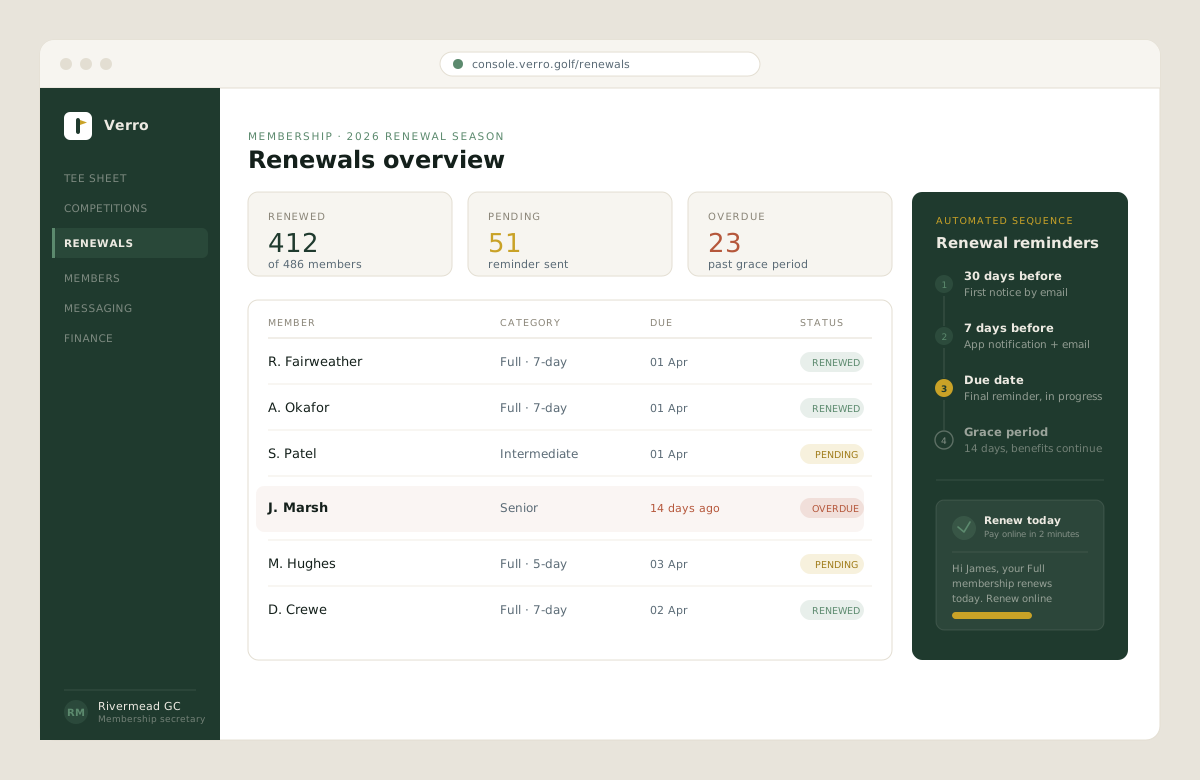
A cadence that works well across most clubs looks like this:
- 10 to 12 weeks before renewal is due. First notice. State the amount, the due date, and how to pay. This is early enough that it does not feel urgent, which is fine. The purpose of this message is to get the date into the member's diary, not to prompt immediate payment.
- 6 weeks before. Second notice. Repeat the key details. Some members will pay at this point simply because it is the second time they have seen the request.
- 2 weeks before. Third notice, with a slightly firmer tone. This is where you mention what happens if payment is not received by the due date, stated factually rather than as a threat.
- On the due date. A short confirmation to members who have paid, and a clear notice to those who have not, setting out the grace period and what happens next.
- 7 to 10 days after the due date. A direct message to anyone still outstanding, ideally from a named person rather than an automated no-reply address.
Five touchpoints sounds like a lot. In practice, most members only need to notice one or two before they act. Different members respond to different messages, and you do not know in advance which one will land for a given person.
The other timing decision worth revisiting is when the renewal period itself falls. A subscription year running January to December asks members to make a significant payment immediately after Christmas, the worst month for household cash flow for a large share of any membership. Clubs that have moved renewal to align with the golfing season, or staggered it across the membership rather than using a single date, generally see fewer late payers simply because the timing works with members' finances rather than against them.
Payment options that reduce friction
The single biggest lever most clubs have not pulled is payment method. If the only way to renew is a cheque or a bank transfer to an account number the member has to look up, you are adding friction at the exact moment you want none.
- A direct payment link in every reminder. Every notice should include a link straight to a payment screen with the amount already filled in. Nobody should have to find a form or work out the sort code again.
- Card and Direct Debit, not just bank transfer. Some members prefer card because it is instant. Others prefer Direct Debit because it removes the decision entirely.
- Instalments for members who want them. Splitting an annual subscription into monthly or quarterly Direct Debit payments removes the size-of-payment problem for the genuinely stretched group, and tends to cut lapses in that group more than any amount of chasing.
- A payment record the member can see. Members who can log in and see what they have paid and what is outstanding are less likely to dispute a reminder or claim they already paid, which removes a meaningful share of the back-and-forth that eats staff time in February and March.
None of this is about being lenient. It is about removing the excuses that turn a five-minute task into a three-week delay.
Handling lapse policy fairly
Clubs need a lapse policy, applied consistently. Inconsistency is what actually damages trust, not the policy itself. A member chased hard while another, friendly with the committee, is quietly let off, notices. So does everyone else eventually.
A fair policy has three characteristics.
It is written down and shared in advance. Every member should know the due date, the grace period, and the consequence of non-payment before renewal season starts, not when they are the one being chased.
The grace period is short but real. Two to four weeks past the due date is typical. Long enough to allow for genuine oversight, short enough that it does not become an informal extension everyone learns to rely on.
The escalation is graduated, not immediate. Playing rights suspended before membership is formally lapsed. A personal call before a letter from the committee. Full lapse, with re-joining fees if applicable, as the final step, not the first. Members treated as forgetful rather than as defaulters, at least initially, are more likely to renew next year even after being late this year.
The goal of a lapse policy is not to punish. It is to protect the members who did pay on time from subsidising, in effect, the ones who did not. Applied consistently and communicated clearly, it rarely causes the conflict that club committees worry about.
What good renewal communication actually looks like
The content of the message matters as much as the timing. A few things separate renewal communication that works from renewal communication that gets ignored.
Lead with the amount and the date. Not a paragraph of preamble about the season ahead. A member scanning an email on their phone should see the number and the deadline in the first line.
Make the action obvious. One clear button or link. Not a phone number to call during office hours, not an attachment to print and post.
Vary the channel. Email is the backbone, but a text message for the final reminder tends to get a faster response than a fourth email, simply because it interrupts differently.
Personalise where it is easy to do so. A message addressed to the member by name, referencing their specific category and amount, performs better than a generic bulk email that reads like it was sent to the whole membership, even though in practice it was.
Say thank you. The members who pay on the first notice, without needing a reminder, rarely hear anything back except silence until next year's letter. A short acknowledgement costs nothing and reinforces the behaviour you want to see repeated.
This is, in practice, what Verro's membership module and communications module are built to handle: a renewal sequence that goes out automatically on the cadence above, payment links straight to a pre-filled Direct Debit, card, or instalment option, and a status view showing the membership secretary exactly who has paid, who is due a reminder, and who has moved into the lapse period, without anyone building a spreadsheet to track it.
It is worth being precise about what this kind of automation actually is, and is not, especially with AI now attached to almost every vendor's marketing. A scheduled reminder sequence is genuinely useful automation. It is not artificial intelligence, and it should not need to pretend to be. We go into that distinction properly in what AI in golf club management actually means.
The takeaway
Late renewal payment is rarely about members who do not want to pay. It is about a process that asks too much of members who are busy, and gives them too few easy moments to act. Fix the timing, remove the friction from paying, apply the lapse policy consistently, and write communication that gets read on a phone in thirty seconds. Most clubs that do this see their list of chronic late payers shrink to a genuinely small number within a season or two.
If you want to see how the renewal sequence, payment options, and status tracking work together in practice, book a demo and we will set it up using your club's own membership categories and renewal dates.
Adam Lynch is the founder of Verro. He previously served as Assistant Director of Digital Media at The R&A and as CEO of WooRank, a SaaS platform acquired in 2023.