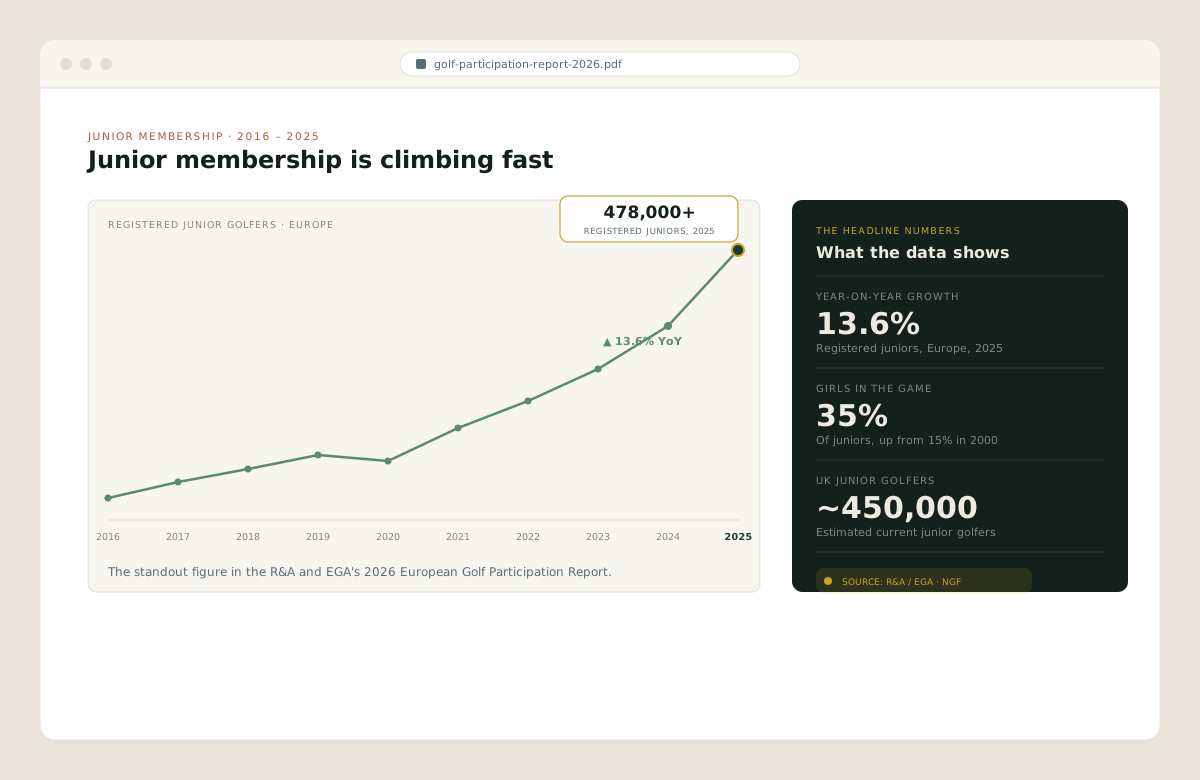
The R&A and European Golf Association's 2026 European Golf Participation Report, based on 2025 figures from member federations, recorded the number of registered junior golfers across Europe rising to over 478,000, a 13.6% increase on the year before. The report itself describes this as the standout figure in the data. It is worth taking that description at face value rather than filing it under general good news.
The same pattern shows up everywhere else researchers have looked. The National Golf Foundation's data shows junior participation in the United States up 58% since 2019, the largest increase of any age group the NGF tracks, with just under four million juniors playing golf on a course in 2025, more than in any year since 2004. Girls now make up 35% of junior golfers, more than double the 15% recorded in 2000. In the UK, junior numbers are estimated at around 450,000, and the 2025 Golfshake Club Membership Survey found junior participation posting a 10.5 percentage point year-on-year gain, the largest of any membership segment in the survey.
What is actually driving junior golf growth
Three things are doing most of the work. Widening access programmes, run by national federations and increasingly by clubs themselves, have made trying the game cheaper and less intimidating for a family with no existing connection to golf. Family-focused initiatives, rather than junior-only coaching bolted onto an adult-first club, bring parents in alongside children rather than dropping a child off at the gate.
The third factor matters more than clubs tend to credit. Off-course formats, driving ranges, indoor simulators, and short-format facilities, are introducing children to golf years before they ever set foot on an 18-hole course. A child who has hit balls at a range with a parent since they were seven arrives at a club's junior programme already comfortable with a club in their hands. That changes what a junior section needs to deliver, and how early a club's actual pipeline begins.
Why this is a structural shift, not a marketing narrative
It is worth being precise about why this is different from the usual "golf is thriving" content that circulates every spring. This is not one report. It is the R&A and EGA's federation-level data, the NGF's US participation tracking, and an independent UK club survey, all describing the same direction of travel across three separate markets using three separate methodologies.
The girls' participation figure makes the same point from a different angle. Fifteen per cent to 35% is not a one-year blip. It is a quarter-century trend that has held up across multiple economic cycles and, in the US data, survived a pandemic that briefly reshaped who played golf and how. A junior membership boom that shows up consistently across independent sources, over multiple years, in multiple countries, is not a narrative. It is a pipeline, and pipelines need planning.
That trend does not stop at 18. The same shift is showing up further along the pipeline too, in adult participation data covered in our piece on women's golf growth, which is worth reading alongside this one if your club is planning membership structure for the next decade rather than just the next intake of juniors.
What it means for junior membership category structure
Most clubs built their junior category years ago, as a single flat rate or a simple two-tier split, and have not revisited it since. A pipeline growing at double-digit annual rates does not fit neatly into a structure designed for steady, predictable numbers.
Age-banded pricing that steps up automatically as a junior gets older removes one recurring admin task and one recurring source of parent confusion. A genuine family membership category, priced and structured as a single household decision rather than as several separate junior sign-ups, tends to convert better than asking parents to enrol each child individually. Clubs that manage membership categories as a living structure, reviewed against actual uptake rather than left alone once it is set up, are better placed to absorb this kind of growth without a committee meeting every time a category needs adjusting.
The coaching capacity problem clubs are not planning for
A rising junior pipeline is only good news if a club can actually coach the juniors arriving in it. Coaching capacity is usually the first constraint to bite, and it bites quietly. A waiting list for junior coaching does not show up in a membership report. It shows up as a family who tried once, could not get a slot, and did not try again.
Clubs planning for this growth rather than reacting to it are doing three things: reviewing coach-to-junior ratios against current and projected numbers rather than historical ones, building group coaching formats that make better use of a single coach's time as volumes rise, and treating coach recruitment as a membership growth decision rather than a pro shop staffing decision. The clubs that get caught out are the ones who discover their coaching capacity was the actual ceiling on junior growth, well after the parents who hit that ceiling have gone elsewhere.
Family communication is now part of the junior membership job
A junior member rarely acts alone. Payment usually comes from a parent's account. Event and competition notifications need to reach a parent as well as, or instead of, the junior themselves. Safeguarding requirements mean some communication has to go through a recognised parent or guardian by design, not by convenience.
That means junior membership communication is really two audiences wearing one membership record: the junior who plays, and the parent who pays, drives, and decides whether to renew. Clubs that treat this as a single communication stream, sending the same message to whichever contact detail happens to be on file, generate confusion at exactly the volume that junior growth is now producing. Clubs that plan for two audiences from the start do not.
The risk of under-investing right now
The clubs most exposed here are not the ones ignoring junior golf entirely. They are the ones treating current junior numbers as roughly steady state and making incremental decisions accordingly, just as the underlying data says the opposite is true. A club that under-invests in junior membership structure, coaching capacity, and family communication during a genuine growth period does not stay flat. It loses the families who tried, found friction, and quietly chose a club down the road that had already sorted its junior pathway out.
Whether that pathway runs through a private members' club or a public course building a junior programme from scratch, the underlying planning question is the same: does the club's membership structure, coaching rota, and family communication assume the junior pipeline of five years ago, or the one the data now shows.
Flexible membership category configuration will not coach a single junior or book a single coaching slot. What it does is remove one obstacle: a club whose junior and family categories can be adjusted in an afternoon, rather than redesigned from scratch, can respond to this kind of growth as it happens instead of a year after the waiting list has already formed.
Adam Lynch is the founder of Verro. He previously served as Assistant Director of Digital Media at The R&A and as CEO of WooRank, a SaaS platform acquired in 2023.