Golf club SEO is a strange category. It gets sold like any other local business's search marketing: a monthly retainer full of technical audits, keyword reports, and backlink outreach. Almost none of that addresses how someone actually finds a golf club to play at.
The buying decision here is local and comparison-driven. Someone searches for a course within a reasonable drive, sees three or four options on their phone, and picks based on distance, availability, and what other golfers say about the place. That is closer to how someone chooses a restaurant than how someone chooses enterprise software. Most of the SEO industry's standard toolkit was built for the second kind of decision, not the first.
Why this is a local search problem, not a rankings problem
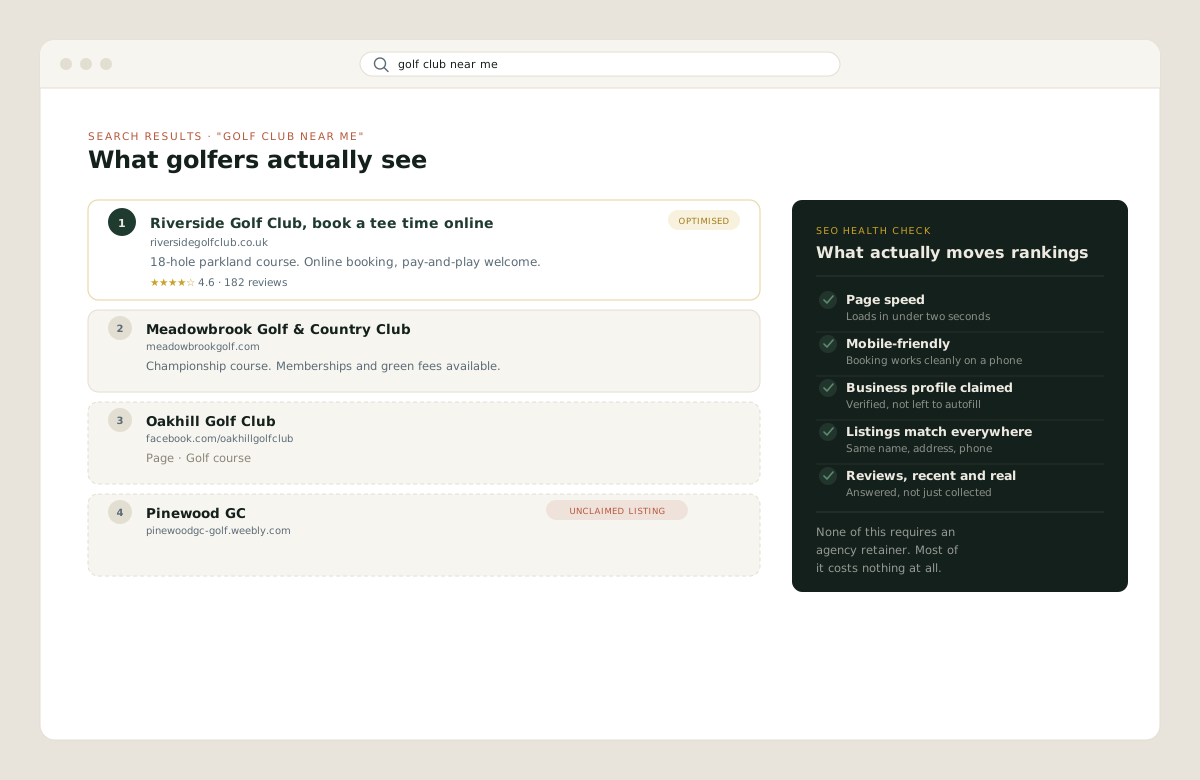
Golfers overwhelmingly search for courses within driving distance. Nobody searches "best golf club in England." They search "golf club near me," or the name of their town plus "golf," on a phone, often with a specific date or tee time already in mind. That search triggers Google's local pack, the map and three listings shown above the ordinary organic results, and the local pack is won on a different set of signals entirely: proximity, a complete and verified Google Business Profile, and genuine reviews.
This matters more for some clubs than others. A private members' club with a stable membership base depends less on someone finding it via search today. A public or pay-and-play course, or any club chasing visitor green fee and society revenue, lives or dies by exactly this kind of search, every single week.
Where most golf club SEO actually fails
Before a club spends a penny on an agency, it is worth understanding where the damage is actually happening. In my experience it is almost always one of these four things.
- Thin content. A handful of static pages with no real information about the course, membership options, or how to book, giving search engines and golfers very little to work with.
- Unclaimed or inconsistent listings. The club's name, address, and phone number differ slightly across Google, Bing, and golf directories, which confuses both golfers and search engines about which listing is authoritative.
- Slow sites. Built on an old page builder, loaded with unoptimised photography, taking six or seven seconds to load on a phone on a course's own patchy Wi-Fi.
- A buried booking button. "Book a tee time" is three menu clicks deep, or worse, it sends the golfer off to a completely different, unbranded third-party booking domain that looks nothing like the club they just found.
None of these require a technical SEO audit to diagnose. They require someone at the club to search for their own course from their own phone and honestly note what happens.
What agencies oversell as golf club SEO
I built software that ran exactly this kind of audit for years, at scale, across every industry imaginable. The audit itself was never the hard part. Acting on the three or four things that actually mattered was, and that is where a lot of retainers quietly fail to deliver value.
A monthly report full of schema markup tweaks, generic blog content stuffed with keywords, and backlink outreach packages looks like work. It photographs well in a slide deck. But none of it compensates for an unclaimed Google Business Profile or a booking page that takes six seconds to load. I have watched clubs pay for a year of technical SEO while their actual local listing sat unclaimed the entire time, because nobody on either side checked the basics first.
This is not an argument that no agency does good work. Some do. It is an argument for asking, before signing anything, exactly which of the fundamentals above they are actually going to fix, and in what order.
Speed and mobile decide bookings, not just visibility
Site speed and mobile usability get filed under "technical SEO," which undersells what they actually do. They do not just affect whether someone finds your site. They affect whether the golfer who already found you finishes the booking.
Most tee time searches and most bookings happen on a phone, often in the ten minutes before or during a round, standing in a car park with patchy signal. A booking flow that is slow, or was designed for a desktop screen and never properly adapted, loses that golfer at the exact moment they were ready to pay. That is a lost booking today, not an abstract ranking problem for next quarter.
Is Answer Engine Optimisation worth acting on yet?
Answer Engine Optimisation, or AEO, optimising content so AI-powered search and chat tools surface and recommend a business directly, is now being actively marketed to golf courses as a 2026 trend. I have seen this pattern before. A new acronym arrives just ahead of the tools and behaviour it claims to optimise for, and a new retainer line item appears alongside it.
I am not dismissing it. AI-powered answers are a genuine shift in how people search, and it is worth watching closely. But it is an emerging, largely unproven practice, not an established necessity a club needs to buy into today. The good news is that the fundamentals above, accurate structured information about your club, a fast site, and real reviews, are exactly what both traditional search and AI answer tools rely on to describe a business correctly. Get those right and you are not starting from zero whichever way search moves next.
What to actually do, without hiring anyone
Most of this costs nothing but attention. In order of impact:
- Claim and fully complete your Google Business Profile. Accurate hours, real photos, the correct booking link, and the right categories. This is free and it is the single most effective thing on this list.
- Make your name, address, and phone number match exactly everywhere you are listed. Google, Bing, golf directories, your own site footer. Small mismatches erode trust in the listing.
- Ask for reviews after good rounds and events, and respond to every one. Genuine, recent reviews outweigh almost anything else in a local, comparison-driven decision.
- Run a free page speed test and fix the worst offender. It is almost always unoptimised images.
- Put "Book a tee time" somewhere obvious. Ideally in the header, not buried in a menu.
- Try booking on your own phone. If it frustrates you, it is losing you golfers.
None of this requires new software or an agency retainer. Where a platform like Verro helps is the boring half: a site and booking flow that is fast and mobile-friendly by default, because it was built as one connected system rather than bolted together from a page builder and a booking widget living on a separate, unbranded domain. That is a foundation. It is not a substitute for the local listing work above, and I would rather tell you that plainly than sell you an audit.
Adam Lynch is the founder of Verro. He previously served as Assistant Director of Digital Media at The R&A and as CEO of WooRank, a SaaS platform acquired in 2023.