Software mergers rarely change what a club sees on screen the week they happen. They change what happens over the following two or three years: which features get built, which get quietly shelved, and who picks up the phone when something breaks. That is worth understanding before a club signs a multi-year contract with any vendor, not after.
The Xplor-Clubessential merger is the largest consolidation golf club management software has seen in some time, but it is not an isolated event. It is one data point in a pattern that has been building for a few years, and clubs currently evaluating or renewing a contract should read it as exactly that. I have run a SaaS company through an acquisition myself. Consolidation is not automatically a problem for the customers caught inside it, but it is never neutral either.
What actually happened in March 2026
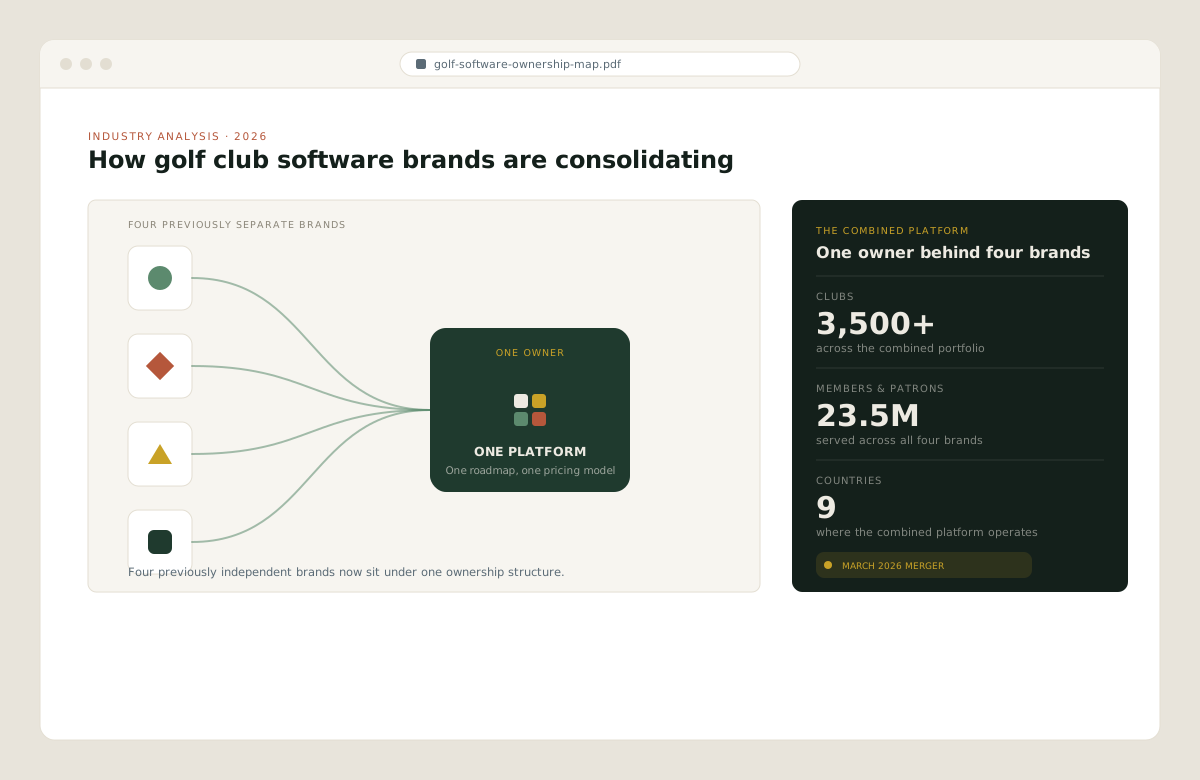
Xplor Technologies completed its merger with Clubessential Holdings, combining Clubessential, foreUP, taskTracker, and BlueGolf under a single Xplor Golf & Club brand. The combined business now supports more than 3,500 customers across nine countries, serving more than 23.5 million members and patrons. That is a genuinely large footprint, built from products that were, until recently, run as separate companies with separate roadmaps.
It is also not the first time this has happened in golf club management software, and it will not be the last. In the UK, ClearCourse's 2022 acquisition of Club Systems International, the company behind ClubV1, and of HowDidiDo, alongside its existing ownership of intelligentgolf, already put several of the most recognised British club software brands under one parent group. Goldman Sachs has publicly flagged 2026 as a year when very large software assets are expected to come to market in golf, a view shaped in part by the private equity interest that followed the Topgolf acquisition. Clubs evaluating software this year are doing so in a market that is actively consolidating around them, whether or not any individual vendor mentions it in the sales process.
What actually changes for a club
None of this means a club's software stops working the day a deal closes. What it means is that decisions which used to be made by one company, answerable to one set of customers, are now made by a portfolio owner weighing several products against each other. Four areas tend to shift first.
Support structure. A support team that used to answer only for one product may now be reorganised around the wider portfolio, with different tiers, different response times, or a different first point of contact than the club was used to.
Product roadmap priorities. A feature request that made sense for a single, focused product now has to compete for engineering time against requests from every other brand in the portfolio. Work that benefits the largest or most strategically important brand tends to get built first.
Pricing models. A portfolio owner has more room to restructure pricing at renewal, bundle products together, or encourage a migration onto a shared platform, sometimes on a timeline the club did not choose and did not budget for.
Feature deprioritisation. The most understated risk is also the most common one. A feature that mattered to your club, but does not scale across the wider portfolio, is a natural candidate to be quietly deprioritised, not because it stopped working, but because it stopped being anyone's priority to maintain.
None of this is a criticism of Xplor, Clubessential, or ClearCourse specifically. It is simply how portfolio ownership works, anywhere in software. A club that understands this can ask better questions before signing, rather than discovering the answer at renewal.
Questions worth asking before you sign or renew
Whether you run a members' club, a multi-course group, or a public course, these questions apply the same way. Ask them of any vendor, not just the ones that have recently changed hands.
- Who actually owns the company behind this product, and has that changed in the last three years? A vendor's own website is not always the fastest way to find out. Companies House, or the equivalent register in the vendor's home market, usually is.
- Is my product due to be migrated onto a different platform, and on what timeline? Portfolio owners frequently consolidate several acquired products onto one underlying platform over time. Ask directly whether that is planned for the system you are being asked to buy.
- Who sets the product roadmap, and does my club get any say in what gets prioritised? A clear answer, rather than a vague one about a customer advisory board that has not met in a year, tells you a great deal.
- What happens to support if my product is one of the smaller brands in the portfolio? Ask for the actual support structure, not the marketing description of it.
- Is my contract pricing fixed, or can it be repriced at renewal to reflect a new ownership structure? Get the answer in writing, in the contract, not in a sales call.
- If my platform is eventually sunset in favour of a sibling product, what is the migration path, and who pays for it? This has happened before in this market. It will happen again.
The honest case for independent ownership
It would be easy, writing this from where I sit, to present independent ownership as the obviously correct answer. It is not that simple, and clubs deserve a straighter account than that.
An independently owned platform answers to the clubs using it, not to a portfolio strategy spanning several brands with different needs. Its roadmap decisions are made by people who only succeed if that one product succeeds. That is a real structural difference, and it is worth something.
It is not automatically better. Independent companies can run out of runway. They can be acquired themselves, sometimes on far less favourable terms for customers than a well-run portfolio merger. A small independent vendor with a weak product roadmap is a worse bet than a well-supported product inside a larger, well-run group. Ownership structure is one input into that decision, not the whole of it.
What independent ownership actually offers is a different kind of risk, not a guaranteed absence of risk. A club betting on an independent vendor is betting on that company's judgment, financial discipline, and staying power. A club betting on a portfolio brand is betting that its product stays a genuine priority inside a larger group with other products to fund. Both are bets. Neither is free of one.
What to do with this
Before signing or renewing a contract for golf club management software, do the ownership diligence you would do for any other significant, multi-year supplier relationship. Ask who owns the company. Ask what the roadmap commitments actually are, in writing. Ask what happens to your product if the portfolio strategy shifts.
Verro is independently owned. We are not part of a wider portfolio of acquired brands, and our roadmap is set by the clubs using the Verro platform, not by where a product sits in a group strategy. That is a factual difference in how the company is structured, not a claim that independence alone makes better software. Judge that on the product itself.
If you are currently evaluating vendors and want to talk through what ownership structure means for your specific contract, book a demo and ask us the same questions listed above. We would rather answer them now than have you discover the answers at renewal.
Adam Lynch is the founder of Verro. He previously served as Assistant Director of Digital Media at The R&A and as CEO of WooRank, a SaaS platform acquired in 2023.