UK clubs are deploying autonomous mowers on fairways, and the reason they give is consistent. The aim is not to run a course with fewer people. It is to free greenkeeping staff from routine cutting so they can spend that time on higher-value work: the detail that separates a well-presented course from an adequate one. Robotic mowers are an unusually clear case of technology arriving in golf, because you can stand on a fairway and watch one work.
A note on sources before going further. Many of the published case studies come from the manufacturers themselves, which is worth remembering when you read them. The most candid material I found is a round table run by BIGGA, where greenkeepers describe what worked, what did not, and what they would want to know before buying. This piece leans on that as much as on the polished case studies.
What robotic mowers are already doing on UK courses
Carus Green, an 18-hole course in the Lake District, has run a fleet of ten Husqvarna robotic mowers since August 2023. Its course manager reports that bunker edging, which used to happen once a fortnight, now happens weekly, because the team has capacity it did not have before. One machine on the driving range alone removed a meaningful number of weekly labour hours. This is a manufacturer case study, so read it as evidence of what is possible rather than a guarantee.
Rowlands Castle Golf Club, with a five-strong greenkeeping team looking after 18 fairways, brought in Kress robotic mowers in September. The club describes a team that used to just about finish the week's work by Friday, always chasing its tail, and now has more time for finer detail. It also points to winter, when getting conventional machinery onto a soft course risks turf damage and a long recovery in spring.
At the BIGGA round table, greenkeepers described robots cutting semi-rough consistently three times a week, against once a week under a traditional schedule, and cutting fairways to a standard one described as fantastic. These are working greenkeepers, not sales teams, and they were just as ready to talk about where the machines fall short.
What robotic mowers replace, and what they do not
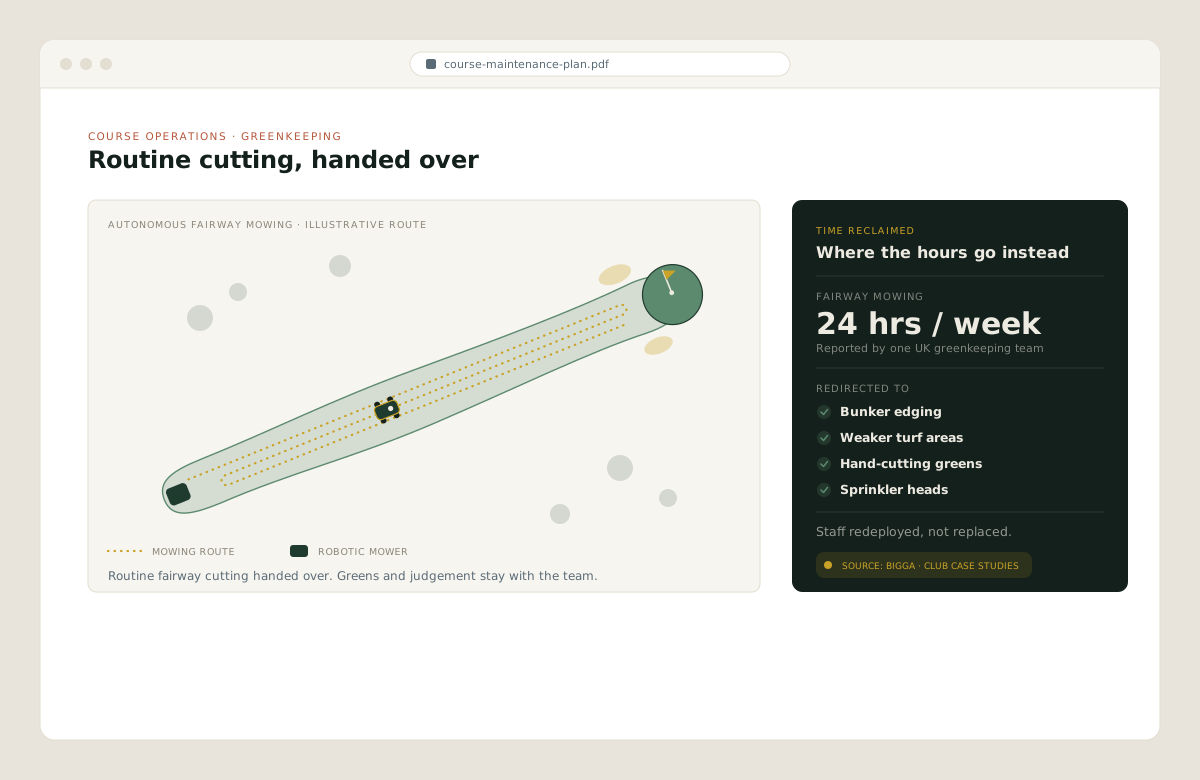
They replace routine cutting of fairways, rough, and semi-rough. That is a real and substantial job. At one course discussed at the round table, fairway mowing alone took two members of staff a combined 24 hours a week. It is repetitive, weather-dependent, and needs doing on schedule whatever else is happening on the course.
They do not replace greenkeeping judgement, and they cannot cut greens. The machines discussed can cut down to around 10 millimetres. Greens are kept at less than half that height, so they remain beyond what an automated machine can do. Reading turf condition, spotting disease early, deciding when to water, aerate, or leave alone, and the hand work that makes a green play well are skilled decisions that stay with the team.
Nor are the machines something you can send out and forget. One greenkeeper was direct about this: they need ongoing attention, and treating them as fit-and-forget is a mistake. The labour does not disappear. It changes shape, from operating a mower to supervising a fleet and keeping it working.
Part of a wider pattern of course technology investment
Robotic mowing does not sit in isolation. Across UK facilities, the same instinct shows up elsewhere: practice ranges with ball tracking and video analysis, floodlit bays and tee times, and other facility upgrades aimed at making better use of the hours and the land a club already has. These are more common than they were a few years ago.
I have deliberately left out headline percentages for how widespread each of these is. Several figures quoted online trace back to aggregator sites rather than a named survey, and a number you cannot trace is worse than no number. The direction is clear enough without them: clubs are investing in facilities that extend what a course can offer, and course maintenance is now part of that conversation.
The practical case for robotic mowers
The strongest argument is capacity. If fairway mowing consumes a meaningful slice of the team's week, and a machine takes most of it, the reclaimed hours can go to work that visibly improves the course: edging bunkers more often, treating weaker turf areas, cleaning course furniture, checking sprinkler heads, and hand-cutting greens. Those are the jobs that tend to slip when a small team is stretched.
There are secondary benefits too. Carus Green reports being able to mow in March and April, when traditional mowers could not operate, and members noticing cleaner fairway edges, less noise, and fewer tyre marks. Consistency of cut is another. A machine that runs on schedule does not have a bad week.
The catch is that the benefit only exists if the time is redeployed on purpose. Hours reclaimed and then absorbed by general drift are not a saving of any kind. A committee should ask what the reclaimed time will be spent on, and how it will know.
The case against robotic mowers, or at least the caveats
Terrain is the first one. A greenkeeper at the round table trialled a machine on a 1920s course and found it scalped the surface in places, which he put down to the contouring and the width of the cutting deck. On the same course, a different greenkeeper found a machine handled an undulating green surround well. Suitability depends on the course, and the honest answer is to test on your own ground.
Trees are the second. One greenkeeper reported machines losing satellite signal under dense tree cover and getting stuck, which means downtime and someone going to fetch them. A heavily wooded course is a different proposition from open parkland.
The third is cost, and it is the one I would press hardest on. None of the published case studies I found puts a price on any of this. Not the purchase or lease, not the servicing, not the running costs over five years. That is not proof the numbers are bad. It is a reason to ask for them in writing, and to compare the total against what the same money could do elsewhere on the course.
How this fits the course budget conversation
The most useful way to frame this for a committee is as a staffing and capacity decision, not a gadget purchase. The question is not whether robotic mowers are impressive. It is whether the hours they free up, spent in the way the head greenkeeper says they should be, produce a better course than the same money spent another way.
That answer differs by club. A private members' club answers to a committee and a membership with fixed expectations of presentation. A public or pay-and-play course is judged on condition by every visitor, every day. A multi-course group may be able to spread a fleet and its maintenance across several sites. Same technology, three different business cases.
If a club is seriously considering it, the sensible route is narrow: ask the head greenkeeper what they would do with the reclaimed hours, get full costs in writing, and test on a limited area of your own course before committing to a fleet. Treat manufacturer case studies as a starting point, and put your own questions to a club that has done it.
Adam Lynch is the founder of Verro. He previously served as Assistant Director of Digital Media at The R&A and as CEO of WooRank, a SaaS platform acquired in 2023.